
You Are the Product
What happens when capitalism runs out of frontiers and starts mining the mind

Last week, a slide from Lightspeed Southeast Asia started circulating on LinkedIn. The title stopped people in their tracks:
“Cheap dopamine as an investment thesis.”
It described how lower-income users spend more time on social media, consume more sugary drinks, and make more microtransactions in free-to-play games. The guidelines for targeting these groups included “instant gratification,” low pricing, and rapid payback cycles.
In plain terms: monetise distraction where it’s cheapest.
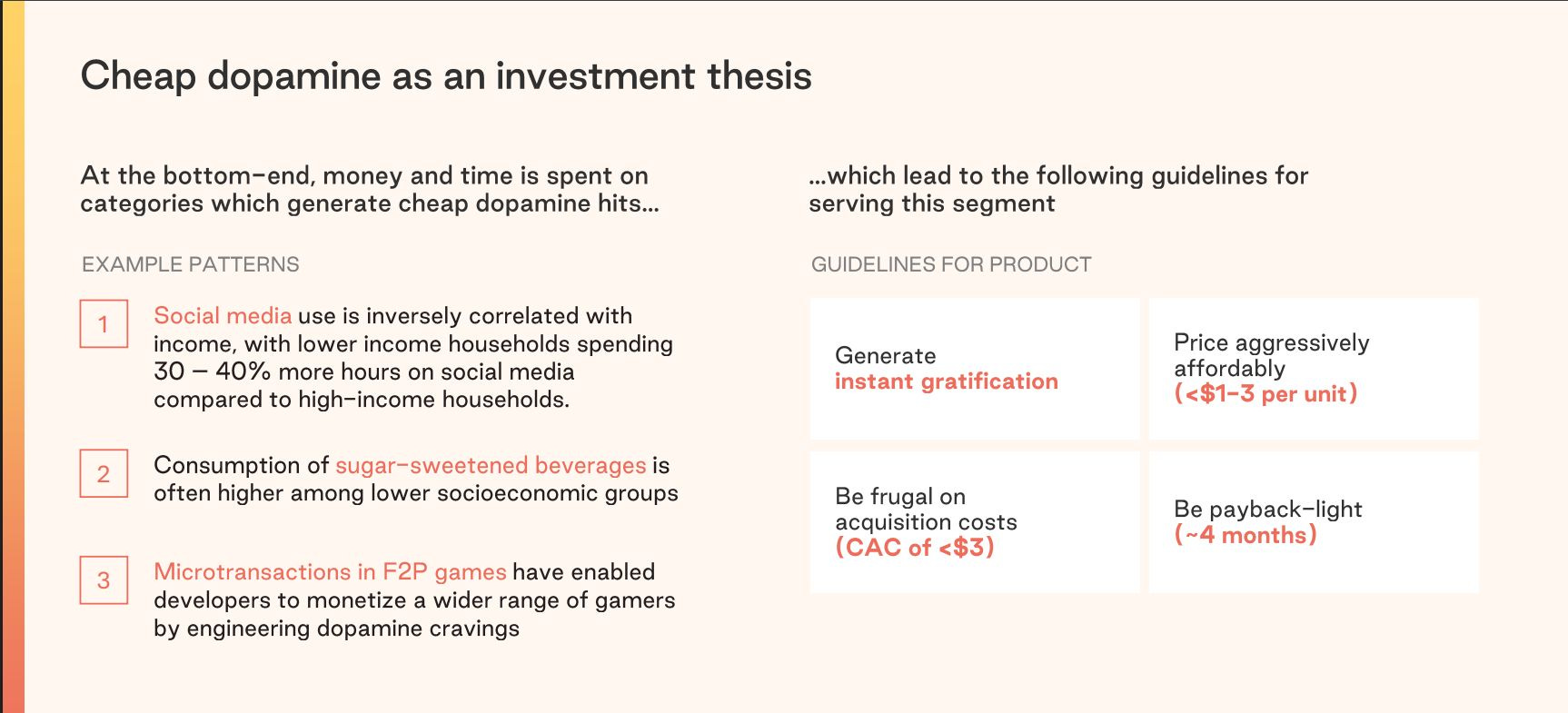
What’s striking isn’t that someone wrote this, it’s that it was presented as strategy. A clean, data-backed roadmap for capturing the attention of people with the least to spare.
This is what capitalism looks like when it runs out of physical frontiers. It turns inward, colonising the human mind.
The New Subprime: Attention
In 2008, greed broke the banks.
In 2025, distraction will break the brain.
The last financial crisis was fuelled by easy credit.
This one is fuelled by easy dopamine.
Billions of hours vanish daily into screens, not as recreation but as surrender; a silent transfer of agency from the individual to the algorithm. We once traded paper, then data. Now we trade time. And it is the most valuable asset of all.
Attention has become the new collateral.
The Wall Street of Dopamine
Every scroll is a micro-trade. Every click adjusts the market.
The new financiers of attention are engineers, not bankers - machine-learning specialists who model desire the way hedge funds model volatility. Their core insight was simple: the human mind has a price, and it fluctuates by the second.
So they built a global exchange for focus - infinite liquidity, no regulation, and no closing bell. Forget CDOs and mortgage tranches. These are Human-Backed Securities, where your attention is the collateral and your identity the data feed.
The system isn’t driven by greed or malice. It’s driven by optimisation, the relentless pursuit of marginal gains. Every extra second of engagement is another basis point of profit.
The Gospel According to the Feed
Every platform carries its own ideology.
Instagram rewards beauty and exhibition.
Snapchat values contact over conversation.
Twitter/X exalts immediacy and outrage.
Each narrows the field of meaning, replacing reflection with reaction. Books once taught patience. Letters offered intimacy. The feed demands immediacy.
We no longer think; we refresh. We no longer converse; we react. We no longer create; we consume. The algorithm doesn’t need your faith. It only needs your attention.
The Illusion of Free
Social media was never free. It’s simply priced in a currency you didn’t recognise.
If your time is worth $20 an hour and you spend two hours a day on TikTok, you’re effectively paying $1,200 a month in lost awareness.
The model is brutally efficient. The longer you stay, the more predictable you become. Predictability is what advertisers buy. In the 1980s, junk bonds gutted balance sheets. In the 2020s, junk content erodes consciousness.
The Attention Recession
No economy can endlessly extract from a finite resource. Attention is no different.
The data already shows the symptoms: collapsing focus, chronic anxiety, and dependence on constant stimulation. The same firms that engineered these habits now market the remedies - meditation apps, dopamine detoxes, “digital wellness” startups.
It’s an elegant loop: capture the user, then sell them their own recovery. A system that breaks concentration, then sells calm as a subscription.
Cheap Dopamine and Venture Capital
The “cheap dopamine” thesis is a mirror held up to the modern investment mindset.
When growth becomes the only moral compass, the easiest profit comes from exploiting the easiest craving. Investors no longer fund products, they fund compulsions. The playbook is familiar - engineer the habit, scale the habit, monetise the habit.
What makes this dangerous is not its cynicism but its efficiency. The product doesn’t just steal time, it rewires desire.
The Global Front
TikTok is Beijing’s most successful export since gunpowder - an empire built on feedback loops, optimised to colonise attention rather than territory. It conquered the West not through war or tariffs, but through design.
The West built social networks. China built algorithms that know us better than we know ourselves. And Silicon Valley, too proud to resist and too greedy to abstain, cloned the model wholesale.
Now every platform competes for microseconds of consciousness. We’ve industrialised distraction - and we call it innovation.
The Exit Trade
In finance, when a position turns toxic, smart traders exit early. The same logic should be applied to our time.
Treat attention as capital. Invest it in things that compound - relationships, learning, creation, silence. Withdraw it from activities that depreciate - outrage, vanity, noise.
The return on focus is exponential. The cost of distraction is invisible until it’s irreversible. When the music stops - and it always does - the algorithm won’t be left holding the loss. You will.
The Next Frontier
Artificial intelligence will not disrupt this cycle, it will perfect it.
Soon, algorithms will predict vulnerability in real time - sadness, boredom, restlessness - and fill that moment with a purchase. Your emotional states will become tradable assets. Your loneliness will have a price.
The most advanced systems will know when your willpower is about to break and monetise that second before you even feel it. This is not tomorrow’s dystopia but today’s business plan.
And so the question remains: When every impulse is a data point and every feeling is an opportunity, what remains that is truly your own?
Welcome to the market.
You are the product.
(Inspired by Dino Ambrosi’s TEDx talk “The Battle for Your Time: Exposing the Costs of Social Media.” Watch it here.)
Human-Backed Securities! Ouch that hurts
这个趋势/事实在中国其实更加明显